instruments for mediating experience
on the phenomenology of play
figures enter unpolished, unresolved spaces. nothing has been committed to persistence yet. deliberation over structure and modes of presentation ensues.
- this is how play begins to unfold.
on the phenomenology of play
information about the purchase of original works can be found at the end of the article.
there is the effort. I feel a great and terrible shame.
allow me a not-so-brief indulgence.
toys are scattered across a grey wall-to-wall carpeting. they consist of the following:
small carboard cut-outs of printed-out cartoon characters. plastic bottlecaps of various colours. expired credit cards bearing compelling imagery - one features an astronaut. Kinder Egg toys. pebbles with - subjectively - satisfying shapes.
it is only retrospectively that I recognise this as a form of labour, but not the kind of labour you - and I - may be thinking about; not labour as it is currently understood, in its capitalist sense, but joyful labour. truly sovereign labour.
the process of growing up did not terminate the practice for me.
I feel a great and terrible shame. :)
throughout the near entirety of my childhood, my sister is my one and only playmate. I - only I - build the worlds our toys inhabit. I design environments, assign roles, establish narratives, and so I become the engine and foundation of our shared reality.
we play pretend. interruptions occur - we get called to dinner. she exits her role and the world we are in. I do not. I remain within the structure, unwilling to risk its dissolution, making sure everything stays in place, eager - as I was - for her return. if a world feels underdeveloped, if an opening in my stories leads nowhere, the game halts, and her disappointment is immediate, visible, soon turning into boredom and even a tinge of sadness. I fear such outcomes, so I must make sure we avoid them at all times.
in time I get very good at my craft. my worlds acquire a sense of completeness that increasingly begins surpassing that of the external one.
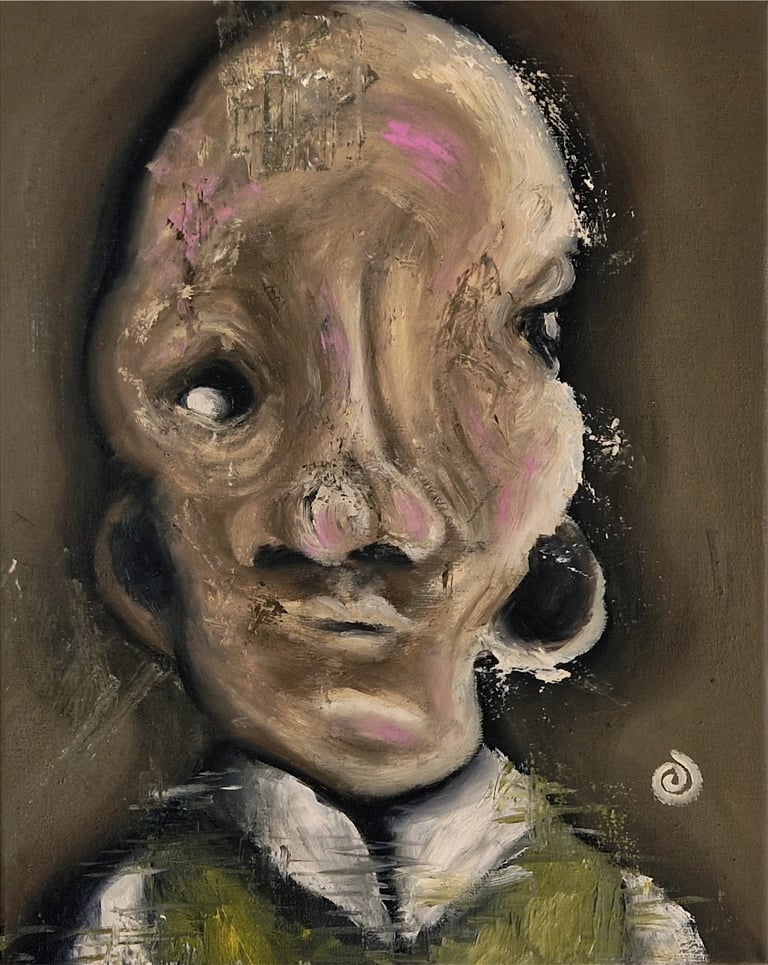
''untitled figure 1''.
oil on canvas.
matte finish.
24cm x 30cm.
''untitled figure 2''.
oil on canvas.
matte finish.
30cm x 30cm.
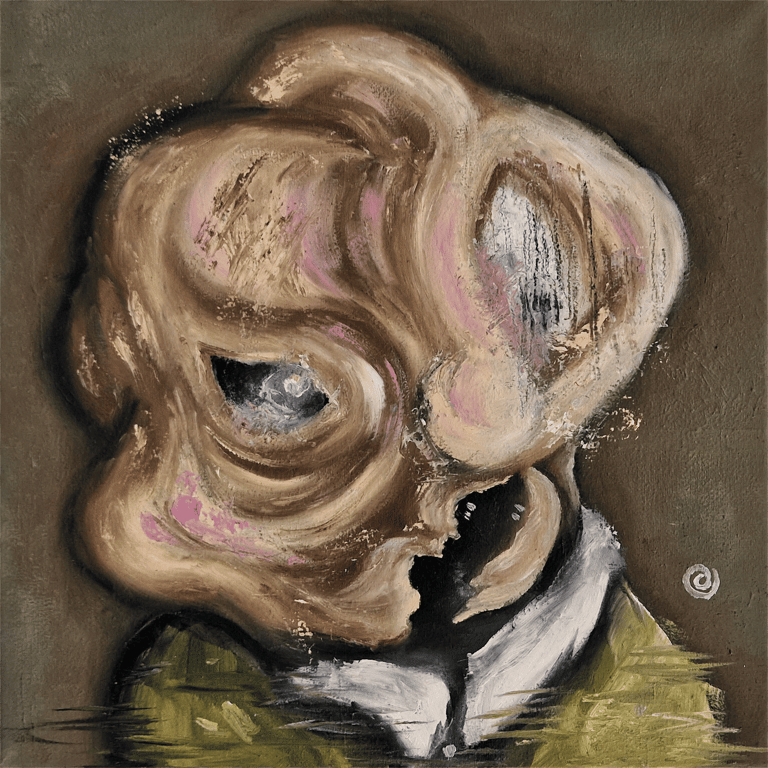
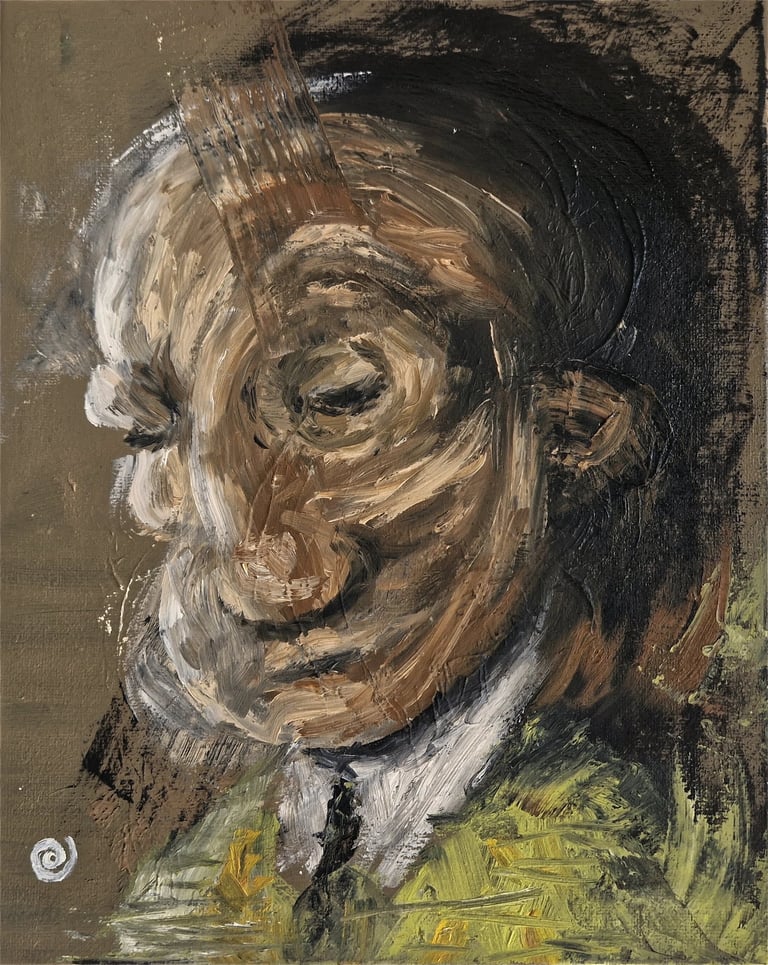
''untitled figure 3''.
oil on canvas.
matte finish.
24cm x 30cm.
the mind is not yet owned.
the ownership of the mind by the external asserts itself gradually and without explicit announcement, advancing inward. result: internal space is reorganized such that thought becomes legible, efficient, productive. children are permitted their imaginary worlds on the implicit condition that these worlds are eventually relinquished, an expectation not inherently malicious. it is simply pragmatism; social reproduction depends upon a return from elsewhere. the difficulty lies not in the demand to mature, but rather in the assumption that maturation entails no meaningful loss.
childhood precedes this regime.
in childhood, before the establishing of these parameters, the mind still knows what it is to move freely. cognition operates under different constraints. play is not a break or recovery between shifts or work days; it is not leisure in the capitalist sense. play is a form of pre-political freedom in a radically true sense of the word.
a child is the best creature at the invention of worlds. it does so - at first - not to escape reality, but to practice its fundamental capacity to transform it. to reimagine what is and what isn't is to rehearse agency.
in '26, like it has been for decades now in the late stages of capitalism, the adult life of the human is defined and evaluated through the confines of a limited and largely uncontested set of parameters: productivity, usefulness, success. justify existence through output; presence must be earned. these standards are so rarely framed as ideological commitments, they are nearly universally accepted as objective coordinates of reality; difficult to interrogate.
__________________
when the tacit and largely unspoken agreement emerged between my sister and myself - that we had, by some shared but undefined metric, become too old to play pretend or too old to engage with toys and such - I did not cease the activity. she did. I continued privately. (because the practice was no longer aligned with what was understood (by whom?) as appropriate.?)
the toys - some of them - vanished. my cognitive apparatus that animated them did not.
I sit on the couch, sometime during the summer preceding my first year of high school.
formally I am there, but truthfully, I am not, as the couch is actually a carriage. I rock back and forth repeatedly, in correspondence to the motion of the carriage across a landscape I constructed in my mind. a question intrudes: are my future classmates in an imaginary transit of their own right now?
(you see, ''knowing!'' reality from fiction is a source of distress here. sometimes not knowing, I believe, is favourable.)
do my future classmates also occupy private conveyances of their imagining, carrying them toward this new social space they are soon to engage with?
I don't know the answer. I'll use this text to ask: were you?
high school functions, in part, as a site of social integration. it is where individuals are trained to operate within expanded systems of evaluation. it introduces the individual to more formalized modes of competition and cooperation, preparing them for participation in a broader social and economic order. in this sense, it serves a collective function: aligning disparate subjects with shared expectations and norms.
in this space, in more complex forms, I continue my imaginative practices. this is especially true with those who come close to me, appearing indirectly. fictional worlds are arranged, roles are assumed and scenarios unfold.
none of these were explicitly framed as play, but they were understood as such - by me, and, I assume, by them also - and the action itself was damn near identical. it (this action which I know to be play in an ineffective disguise) provided a mediated space in which communication could occur with reduced friction. paradoxically, the adoption of roles allowed for greater directness. through shared fiction, proximity became possible.
some of my first 'more complicated' feelings were dealt with through play. most of my others to follow, just the same - even if, now, play is shaped differently yet again.
play is an instrument for mediating experience.
I am currently 25 years old.
I feel a great and terrible shame, and I wish to end its presence.
the shame recurs, as this is how play unfolds nowadays:
cognitively costly experiences are for me filtered through fiction, enabling me to endure tasks I otherwise find unmanageable. it complicates direct engagement with 'the real', but unmediated 'real' feels abrasive, and action without translation generates friction, fatigue, and more often than not, failure.
the term for this condition exists. I encountered it late. it describes the moment at which activity is experienced as externally imposed and internally hollow. my very capacity I have developed in childhood is now being deployed not to generate joy, but to resist the hollowness of 'the real'; to re-enchant actions performed within a system I experience as fundamentally undesirable.
I hope I am not alone.
I question how much of this mode of engagement constitutes adaptation and how much constitutes avoidance. to tackle this question, let me exemplify:
washing dishes is reconfigured into: I am tethered to a vessel, it and I suspended in space. I do extravehicular repairs. the kitchen constricts thought; imagined space permits its expansion, and I become the astronaut on the expired credit card. my hands do not wash dishes - they perform engineering I do not have knowledge to even begin to imagine correctly, but it does not matter (thank god). it is not actually the hand that fixes my spaceship, it is the mind.
taking out the trash: I am delivering a significant parcel to ominous entities of considerable authority, whose reciprocal intervention, transactionally, results in the magical transformation of my household into a 'lower-density accumulation of junk' version of itself. it's trade, you see?
bathing: controlled ritual of partial dissolution, atoms of 'me' begin their adventure beyond the pale of my body, starting with the old plumbing system of the city.
making coffee: I conduct a minor alchemical operation whose end product - a dark, bitter infusion - temporarily instills the faculty of will. in a sense, this isn't even fiction, really.
asthma attacks: a coiled gremlin-like creature sits on my chest, seeking ingress. I consider potential triggers rationally, but the thought is displaced. stolen, actually, by a physician appearing besides me and completing the thought on my behalf. it offers a warning and then vanishes. (this is not delusion, it is dramatization; a reorganization of sensation into a form I can endure)
I shall not count all things I transform into something else, as you get the point. in short, all of it, from job to pastime, pain to pleasure, mundane to extraordinary, it is all *also experienced differently in parallel, my mind choosing to mostly focus on the *also.
*also from the present:
I go to sleep late at night, partly because I am notoriously incompetent at enforcing a hygienic circadian rhythm, and partly because I am attached to the hours at which I know most people in my life have already withdrawn, scattered into their distant and unreachable versions of 'elsewhere', away from 'here' (this 'here' represents thus a rare occasion in which 'the real' adopts a desirable characteristic for me. I like inhabiting the 'here').
sleep is deferred until all external demands have receded. only then do I retreat, with an object in hand. this is a ritual, and rituals demand specification:
the object must be relatively small - no bigger than my thumb - and of a geometry my hand already understands and is familiar with. (used to be one of the Kinder Egg toys, then a metal cross (more on that some other time). nowadays, it is almost always a lighter). this familiarity is essential, as the better I recognise its form, the more effectively I can disregard it, freeing attention instead of capturing it, and allowing my focus to be directed somewhere else.
with eyes closed (sometimes deliberately obscured, along with the exposed ear - I sleep on my side - by fabric) I initiate a continuous and regulated fidgeting of the object, in sync with imagined movements of fictional characters that enact fictional scenarios.
the ritual is used for translating, indirectly, matters of 'the real' that resist direct formulation. the process is analogical, iterative, and it does not slide into dreaming. consciousness remains intact, and the distinction between the ritual and dream is intentional. prior to sleep, I manipulate figures, and in it, I am the figure.
(I am confident this fragment is immediately legible to some. apologies. I never found a satisfactory way of explaining why there is almost always a lighter in the bed by morning. I was always aware of the 'how' it gets there, I am still confused by the 'why'. so I shrug.)
under contemporary conditions, inner life is expected to be regulated not primarily for wellbeing, but for productivity. imagination is tolerated insofar as it yields measurable value. fantasy without output is perceived as regression, as pathology. shame proliferates where freedom once resided.
this text shall not be taken as a wholesale defence. these internal worlds are costly. they function as coping mechanisms, and some are demonstrably maladaptive (acknowledging this does not require moralization, but analytical clarity). they delay action on my part, they deplete energy and often necessitate periods of withdrawal from people I genuinely value, and to which I find it hard to explain these mechanisms upfront. to them, I extend my sincerest apologies.
I no longer wish to experience shame. I imagine. I narrativize survival. I resist the reduction of consciousness to utility. these inner worlds constrict me at times, yet they also preserved me under conditions that afforded little room to breathe, both figuratively and literally.
my mind persistently recalls what it is capable of when unowned. the remaining question is how that capacity might be exercised with intention.
𖦹
so I paint.
the paintings in this project are not directly related to my above ramblings and I do not wish to explain their own, separate, only tangentially related messaging. paintings are not to be directly turned into words, else they would cease to function as images.
''untitled figure 1'' - available for purchase at 200€ (50% to be donated to a beneficiary)
"untitled figure 2" - available for purchase at 200€ (50% to be donated to a beneficiary)
"untitled figure 3" - available for purchase at 200€ (50% to be donated to a beneficiary)
plus an additional 20€ - 40€ cost for the frame (if desired), depending on the frame model the buyer wishes for (the framing process is handled entirely by me).