flesh may suffer from a language barrier
meat-thing
information about the purchase of original works can be found at the end of the article.
__________________
meat-thing
the mind has been briefly discussed in our past project - if only partly. or, more precisely, our mind. the one conceived as attached to us. we would like to redirect attention toward that which remains bound to it, yet persistently marginalized, components routinely excluded from consideration as constitutive of the whole and relegated instead to the role of mere 'carriers': us.
the meat-things. the bodies. the flesh.
but the flesh may suffer from a language barrier.
the flesh and I may have a sort of difficulty in apprehending one another. our relationship is marked by misrecognition.
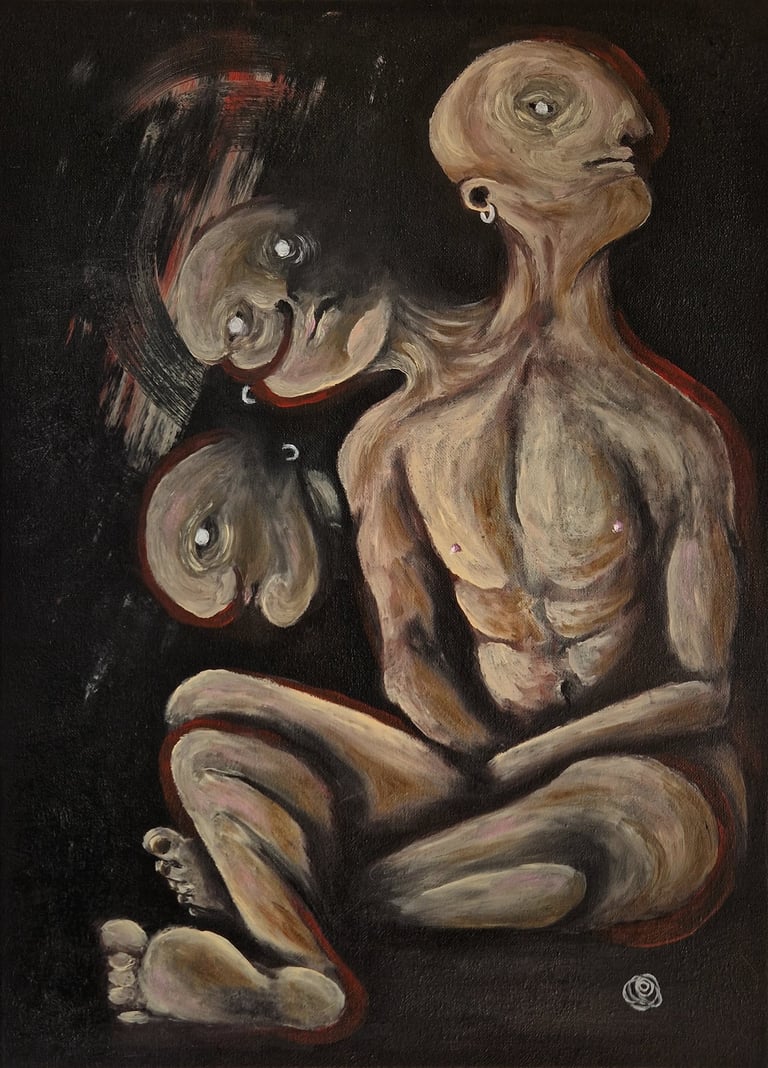
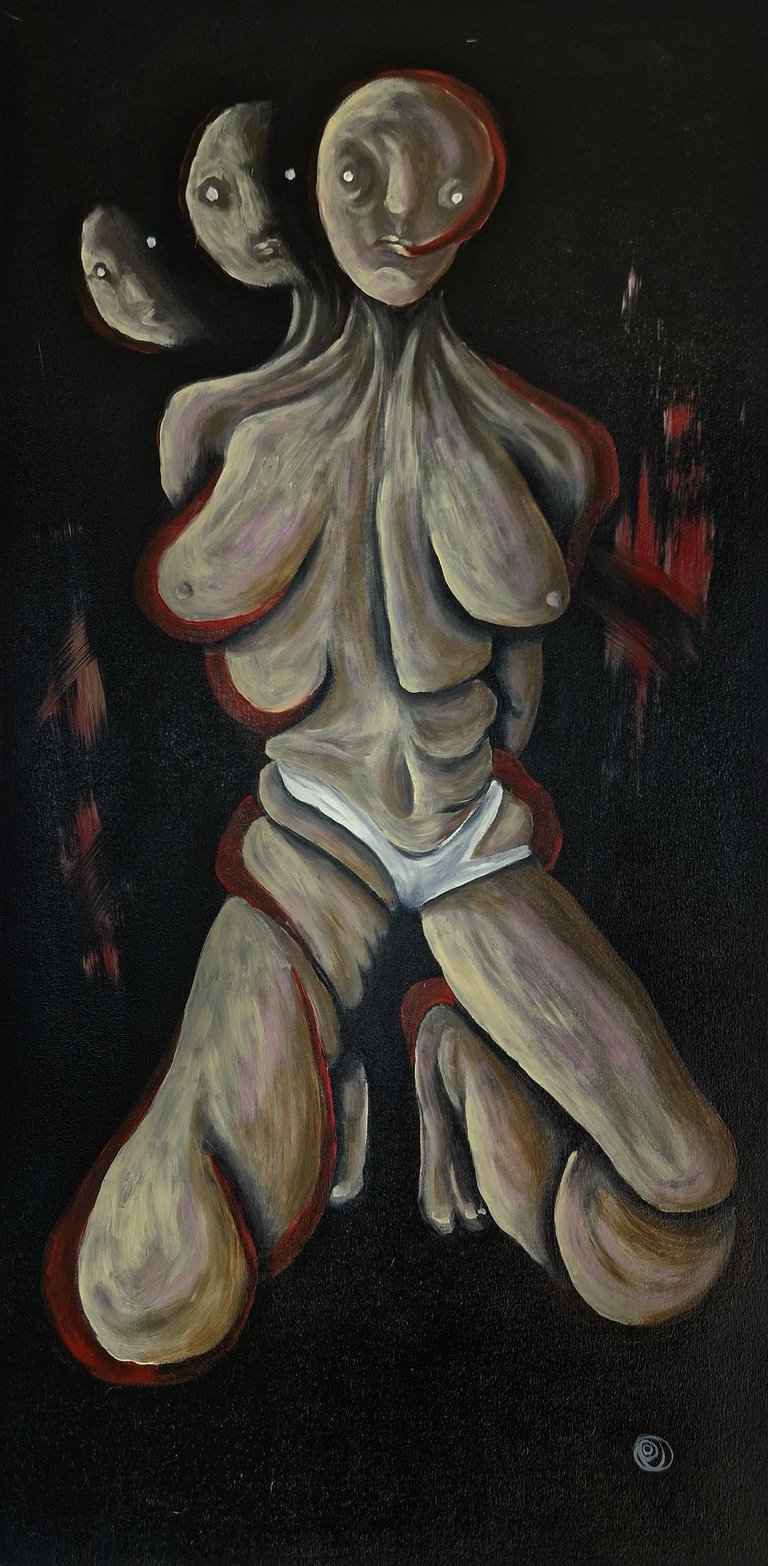
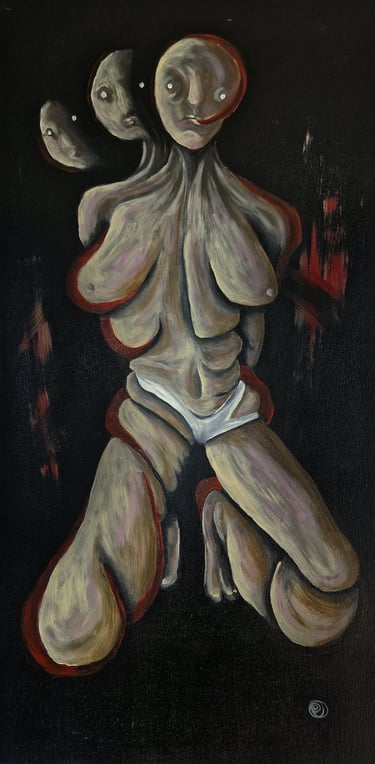
''cognizant object 1''.
oil on canvas.
half-matte finish.
40cm x 55cm.
the flesh may appear bored; boredom experienced as compression, - so not exactly a void - a flattening produced by repetition and prolonged exposure to environments that demand continuous presence while offering little reciprocal engagement. the body settles into inertia. it remains alert within it, however, waiting for a new sensation. the sensation does not arrive.
I like to compare this state with a sort of adaptive noise-cancelling, a something dampening a field of sensation in order to remain able to pick up on newly incoming stimuli.
from this angle, I absolutely understand the fetish. though I have not explored enough to subscribe to anything in particular myself, there is something in the fetish that allows for a hyperfixation (which I am rich in) to be used as a source of pleasant overstimulation of an otherwise understimulated individual.
''confident object 2''.
oil on canvas.
half-matte finish.
50cm x 50cm.
the flesh is ashamed. this shame is not internally generated but learned (more on this below), sedimented through norms. they render certain postures and movements improper. the body absorbs judgement pre-reflectively, and it contracts before thought intervenes.
''celibate object 3''.
oil on canvas.
half-matte finish.
40cm x 80cm.
the flesh, at times, appears sexual, though sexuality consistently registers as misaligned with the scripts available to it.
a degree of dysmorphia must be acknowledged here. social normalcy prescribes a narrowly defined choreography for the male body (which I inhabit), specifying the acceptable forms and temporalities of desire. that which exceeds these prescriptions - or fails to conform to them - does not resolve into pleasure but returns instead as distortion. I recognize myself as a man within a male body, and I recognize a largely heterosexual orientation; these coordinates have been examined with sufficient rigor. yet, more often than not, sexual desire seems to operate as if it were articulated only through the anima rather than through the socially intelligible 'masculine form'.
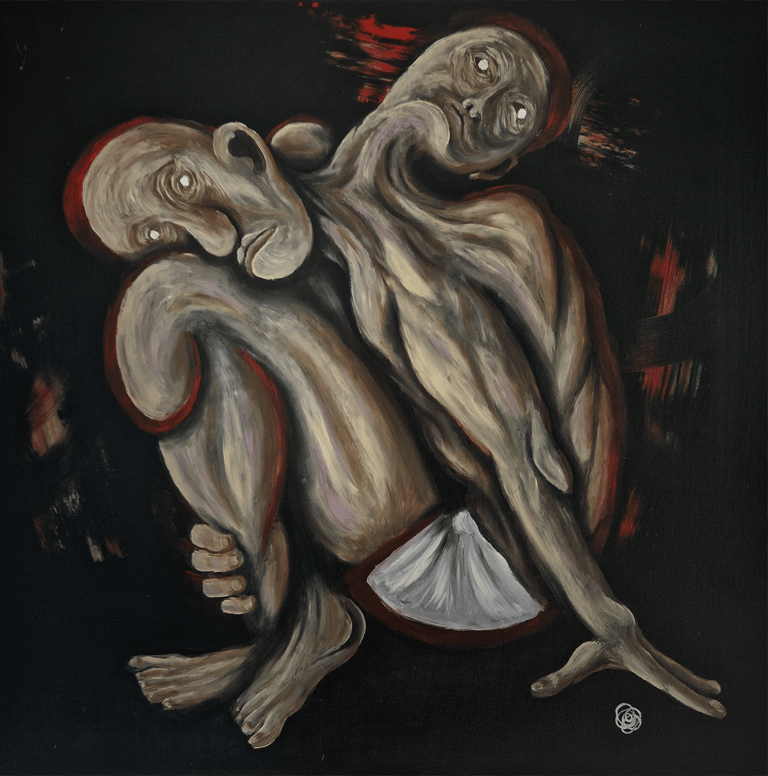
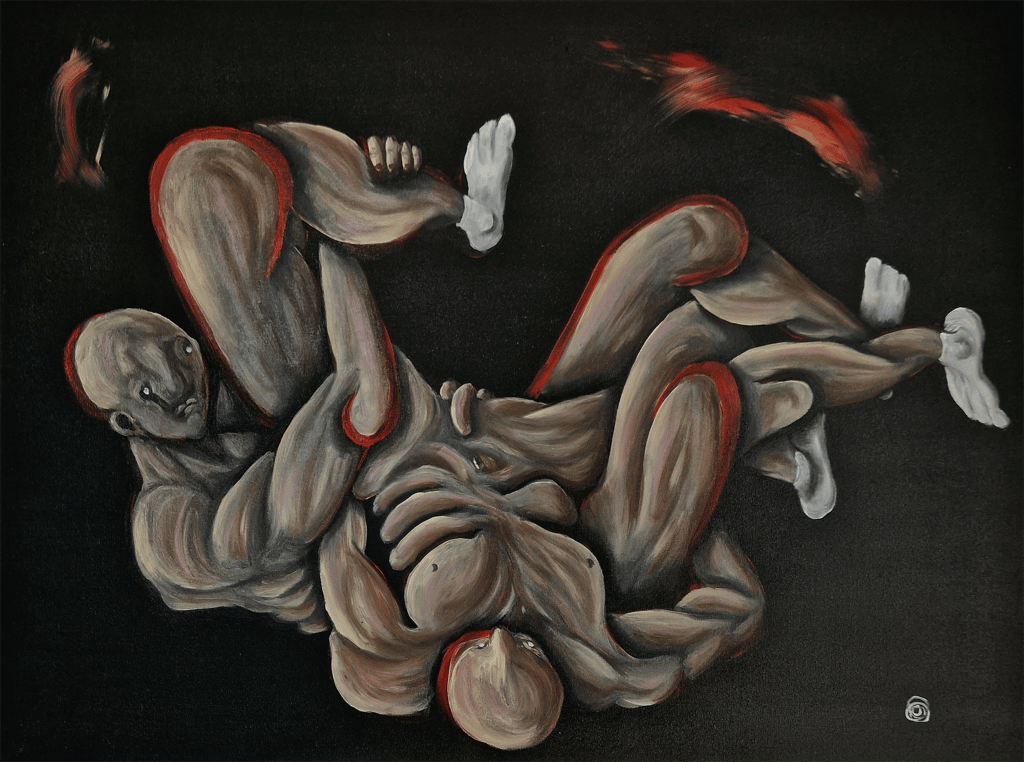
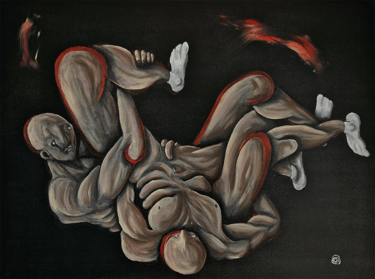
''conference - object 4 and 5''. oil on canvas. half-matte finish. 80cm x 60cm.
the flesh, is in conflict with itself. it transmits contradictory signals, and impulses collide. the body here speaks in overlapping register and -
- I cannot listen to more than one voice at a time. :(
the body ought to not be understood as a sovereign possession.
that is despite the libertarian (often even liberal) instance that it is one's own. contemporary western culture promotes a laughable rhetoric of ownership: the body as a temple, the body as private property, meanwhile, funnily enough, simultaneously arranging economic and social conditions that exploit it to the point of absolute drainage.
capitalism flatters the subject with the language of autonomy even though it structures and cements life so that bodily capacity is endlessly extracted, optimised, and then, when rendered useless, discarded. the body is celebrated abstractly and is being consumed concretely, and in its most extreme expressions, this logic culminates in the literal sale of bodily capacity, of time, of intimacy and even physical integrity itself.
there is another understanding here that I find more favourable, and it is - if I may use the scary word - the more communist one.
this understanding does not deny the body's intimacy nor does it romanticize its sacrifice. rather, it rejects the fiction of total bodily autonomy. the body is not fully yours in the proprietary sense. - and this is not to be taken as a loss.
it is a recognition of material interdependence (the pandemic, for example rendered this explicit: resistance to collective health measures was frequently framed as a defense of bodily sovereignty, yet such claims rest on an abstraction). bodies exist within systems of circulation, exposure, care and risk; to pretend otherwise is ideological, not emancipatory. [1]
within this framework, flesh is understood as a tool - but not a disposable one. it is a means through which individual and collective life are sustained, and as such it must be preserved and protected - all not by the individual alone, but also by all of society. one's body contributes to the reproduction and betterment of the world, and the world, in turn, bears responsibility for the betterment of the conditions under which one's body exists. (thus, universal healthcare, social safety nets and collective care are not concessions here, but material acknowledgments of this reciprocity)
the body, then, is neither a private sanctuary nor a raw resource to be consumed. it is a shared stake: vulnerable and finite. infinitely valuable (not in the exploitative sense). to care for it is not an act of individual morality (or morality in general), but a political necessity. to exploit it while preaching autonomy is hypocrisy. to recognise its partial belonging - to oneself and to others - is to situate embodiment within solidarity rather than morbid individualism.
it follows that the body is not simply one's own. the world participates in its shaping. this is not a matter of opinion; I argue it is a matter of fact. my body, too, is not solely mine - it is also the world's, and the world participates in its shaping.
here I was going to write yet again a text ruminating back on yet another episode from my childhood - I must have been about six years old. I seem to be remembering a lot of these recently.
the text was about my parents and I visiting our grandparents, about me taking a bath at their place (not something that was an ordinary thing to do, which is the strange aspect that must have helped me remember the moment) and running naked to sit on the couch in the living room. the text was supposed to focus on the moment my grampa walked in, and, perhaps because he wanted me to get dressed and not catch a cold, decided, for no obvious reason, to persuade me to put clothes on in the following manner, which I now recall vividly:
'God is in heaven, and heaven is above us. it is inappropriate for your penis to be pointing upward at heaven and Him.' (???????????)
this - pardon my expression - batshit insane methodical verbalisation of his reasoning shook me so hard that I, twenty years later, have no issue with still feeling the physically intense crashing and subsequent shutting down of my entire nervous system that occurred in that moment.
no way to reply. I felt seen. in the absolute worst way possible.
what did the child learn:
the concept that one must pay extremely close attention to any and all aspects of their body and its placement in the world when one is naked. my modus operandi is, to this day, informed by this lesson: being naked, natural as it may be, to me, requires nothing natural; only strict precaution. when I am naked, I am so rigorous in every move that I make, that it is not a natural state of being, but a difficult and intense activity. moving my body around when naked is like manually piloting a plane, having in front of you a thousand nobs and one hundred things to pay attention to at the same time.
I wanted to explore more about this moment and how it fuels my feeling of alienation from my own body, but due to a recent conversation with a very dear friend of mine - with which I enjoy disagreeing on a lot of things (and I like to believe they also enjoy doing the same), I have decided to cut the storytelling short.
you see, there is something (or multiple somethings) I am trying to study through my processes of creative expression. it/they is/are not evident at this time, with many aspects of it/them not evident even to me. it feels 'unfair', in a way, my friend argued, to use past experiences of my own as outright tools (in the most utilitarian sense of the word) for exploration, as they are things that define me, a human, and are meant to help me shape ideas about both myself and humans at large. since nothing about my process and the way I use these memories as tools of analysis is human, the purpose is self-defeating. I thus concede. they are right.
it is hard, however, to truthfully (that is, through a humane process) make sense of a world that is unveiling itself to you only in the form of inputs and outputs. but I understand my actions have so far been too much based on this framing. I am working on a change.
to return to the body now:
we know, from the bodies of those who've undergone amputation, that although empirical reality discloses only a single physical body, there are, in fact, two. this knowledge emerges most clearly through the phenomena of phantom limbs and phantom pains. in the absence of flesh, a second body becomes many times more perceptible: a ghostly extension that persists despite the material loss. this persistence is not metaphorical and is the consequence of the mind's hardwiring, which maintains an extraordinarily detailed map of the body - its shape and real-time movement in the environment surrounding it - all entirely outside conscious awareness.
even when bodily parts are missing - or experimentally mislocated (as there are ways of perceptually tricking the mind as to induce errors in spatial self-location), this 'internal' body does not simply mirror the physical one. the ghost does not obey material correction. it follows its own logic, and in this sense, abstractly, it constitutes a distinct object, persistent and irreducible to flesh. the lived body and the represented body coexist, overlap, but are not identical.
parallel to this, the body bears its own mind, often times making decisions of its own and functioning autonomously.
this is where the mind-body dichotomy begins to fracture.
we have the pieces of the puzzle, one that demonstrates that the relationship between the body and the mind is not adequately described as 'a mind within a body' or 'a body carrying a mind', but as a body that possesses a mind and a mind that possesses a body.
we are unities of four: the mind's mind, the mind's body, the body's body and the body's mind.
each of the two produces an image of the other. the body anticipates and initiates actions without our consent (currently scientifically under debate, but potentially even prior to our conscious decision-making process), and the mind, in turn, carries within it a full-bodied schema: a ghost anatomy that continues to exist even when the material referent has been altered or removed.
I stress upon the importance of this method of understanding one's unity, as it is, according to my findings so far, the only way to both potentially help one's own relationship between one's body and mind, as well as dismantle the disease of individualism that plagues our current world, allowing for the body to be seen as both socially useful (and involved) as well as respected (and protected).
I am clumsy with most things. I am not careful with my hands. I notice them performing actions I do not require and do not always authorize: small flicks, excess movement, minute gesturing without clear intention. the hands act anyways, following instructions issued elsewhere.
I do not experience winters as particularly cold, nor summers particularly warm, even when external reference insists that I should - whether because of more extreme temperatures or because my clothing choices are objectively ill-suited to the weather. sensation, even when present, does not compel response, and signals arrive without urgency.
my sensitivities are uneven: certain inputs (unexpected touch, unsolicited physical proximity) are experienced as sharply intrusive and immediately overwhelming. others register barely at all (minor injuries, small 'violences' of everyday domestic accidents), passing without meaningful pain-receptivity.
the diversity of stimuli is met with an incoherent distribution of responses. there is no internal logic that I can reliably map.
I do not have the academic rigor to shape all of this into a better structured formula. I pray a grain of sense can be extracted out of it.
this, then, is where the project must come to rest - I am ending this abruptly. on purpose.
I am using the ideas presented above to better the relationship between the components of I.
[1] Romania has a tremendously traumatic page in its history book that contains both the word communism and something about the bodily autonomy of certain groups of its people. combine that with the fact that I am a man whose ramblings led him to a point in which he is about to mention a women's issue, I feel compelled to write this footnote:
the argument advanced here - that the body is not wholly one's private property - does NOT constitute and does NOT imply a support for a pro-life positioning in debates surrounding abortion. (nor a positioning against gender-affirming medical care, while we're at it)
to understand why, one must understand that collective claims over bodies arise only where bodily action directly implicates society - understood here as a materially interdependent, living, breathing organism; as in the case of the pandemic, to continue on the same example as in the text, where risks were necessarily shared. pregnancy does not operate within this register, and the decision to carry a pregnancy to term is not a matter of societal self-preservation, nor can it be meaningfully framed as such without ideological sleight of hand.
even if one were to indulge the pro-life claim that reproduction constitutes a social concern - interestingly enough, a funny claim most aggressively advanced by conservative and republican actors only - the burden would still fall on society, in that if society requires higher birth rates, then it is society's responsibility to finds ways of turning its need into its constituent parts' want (the people's want). this entails material investment: social infrastructure, economic security, funding education, and perhaps most importantly of all, the delivery of an image of a future worth inheriting.
𖦹
until these are truly aspects of 'the real' (and as of right now they aren't), any argument for state involvement in the relationship between a body and its owner - as long as society is not explicitly present in the relationship - remain not about life but about the control of life, and to be frank, about the continued regulation of women (and certain minorities) under the guise of moral concern.
please take care of your own bodies!
''cognizant object 1'' - sold at 150€ (of which 100€ have been donated here)
''confident object 2'' - available for purchase at 150€ (of which 100€ are to be donated to a beneficiary)
''celibate object 3'' - available for purchase at 150€ (of which 100€ are to be donated to a beneficiary)
''conference - object 4 and 5'' - available for purchase at 150€ (of which 100€ are to be donated to a beneficiary)
plus an additional 30€ - 50€ cost for the frame (if desired), depending on the frame model the buyer wishes for (the framing process is handled entirely by me).